
What is Self-Compacting Concrete (SCC)?
Self-Compacting Concrete (SCC), also known as self-consolidating concrete, is a highly flowable, non-segregating concrete that can spread under its own weight to fill formwork and completely encapsulate reinforcement without mechanical compaction. It was developed in Japan in the late 1980s to address labor shortages and the need for higher concrete durability. SCC has since evolved into one of the most efficient concrete technologies in the industry.
As a civil engineer with years of field experience in infrastructure and ready-mix operations, I can tell you this: if you want quality, speed, and reduced labor cost in certain critical applications, SCC should be in your toolbox.
Core Characteristics
SCC is defined by three primary characteristics:
1. Flowability: It must be able to flow into all corners of the form without the need for vibration or mechanical compaction.
2. Passing ability: It must be capable of flowing through closely spaced reinforcement without blocking.
3. Segregation resistance: It must maintain a uniform composition during flow to prevent aggregate settlement or paste separation.
This behavior is achieved through precise mix design and specialized admixtures, primarily high-range water reducers (superplasticizers) and viscosity-modifying agents (VMAs) when necessary.
Key Components
While the basic constituents of SCC remain the same as conventional concrete—cement, aggregates, water, and admixtures—the proportions and mix design approach are different. The critical differences are explained below.
Cement and Supplementary Cementitious Materials (SCMs)
SCC often employs a higher cement content combined with SCMs like fly ash, silica fume, metakaolin, or ground granulated blast furnace slag. These improve cohesion, reduce the risk of segregation, and enhance the concrete’s workability and long-term durability.
Aggregates
Fine aggregates play a more significant role in SCC than in regular concrete. A higher proportion of sand improves flow properties and filling ability. Uniform aggregate grading and rounded particles (when available) contribute positively to SCC performance. Maximum aggregate size typically ranges from 12 to 20 mm depending on the structural elements’ spacing.
Water-Reducing Admixtures
High-range water-reducing admixtures are essential to achieve the required slump-flow and viscosity. These admixtures allow high workability while maintaining a low water-cement ratio, ensuring the concrete develops the necessary strength and durability.
Viscosity-Modifying Admixtures (VMAs)
When SCC mixtures are prone to segregation, VMAs are added to stabilize the mix. They do not increase flow but control viscosity to ensure that the concrete does not bleed or segregate during placement.
Mix Design Considerations
Designing a SCC mix involves balancing flowability and stability. You do not chase flow without managing the risk of segregation. The design starts with specifying performance targets rather than tabulated proportions.
Typical parameters include the following:
– Slump Flow: 650–800 mm
– Passing Ability (measured by L-box or J-ring): ratio around 0.8 or higher
– V-Funnel time: 6–12 seconds
– Segregation Resistance: maintained through mix design and aggregates selection
Lab trial mixes and iterative fine-tuning are essential before moving to full-scale production.
Testing Procedures
SCC cannot be tested using traditional slump methods alone. The following specialized tests are used for quality control:
Slump Flow Test (ASTM C1611)
Evaluates the unconfined flow ability of fresh concrete. A higher slump flow means better filling ability. A typical range is between 650 mm and 800 mm.
L-Box Test (EN 12350-10)
Assesses the passing ability of SCC through congested reinforcement. The test uses vertical and horizontal sections to analyze the concrete’s ability to pass through tight openings.
V-Funnel Test (EFNARC)
This test measures the time required for concrete to flow through a narrow opening, indicating its viscosity. Faster flow means lower viscosity and vice versa.
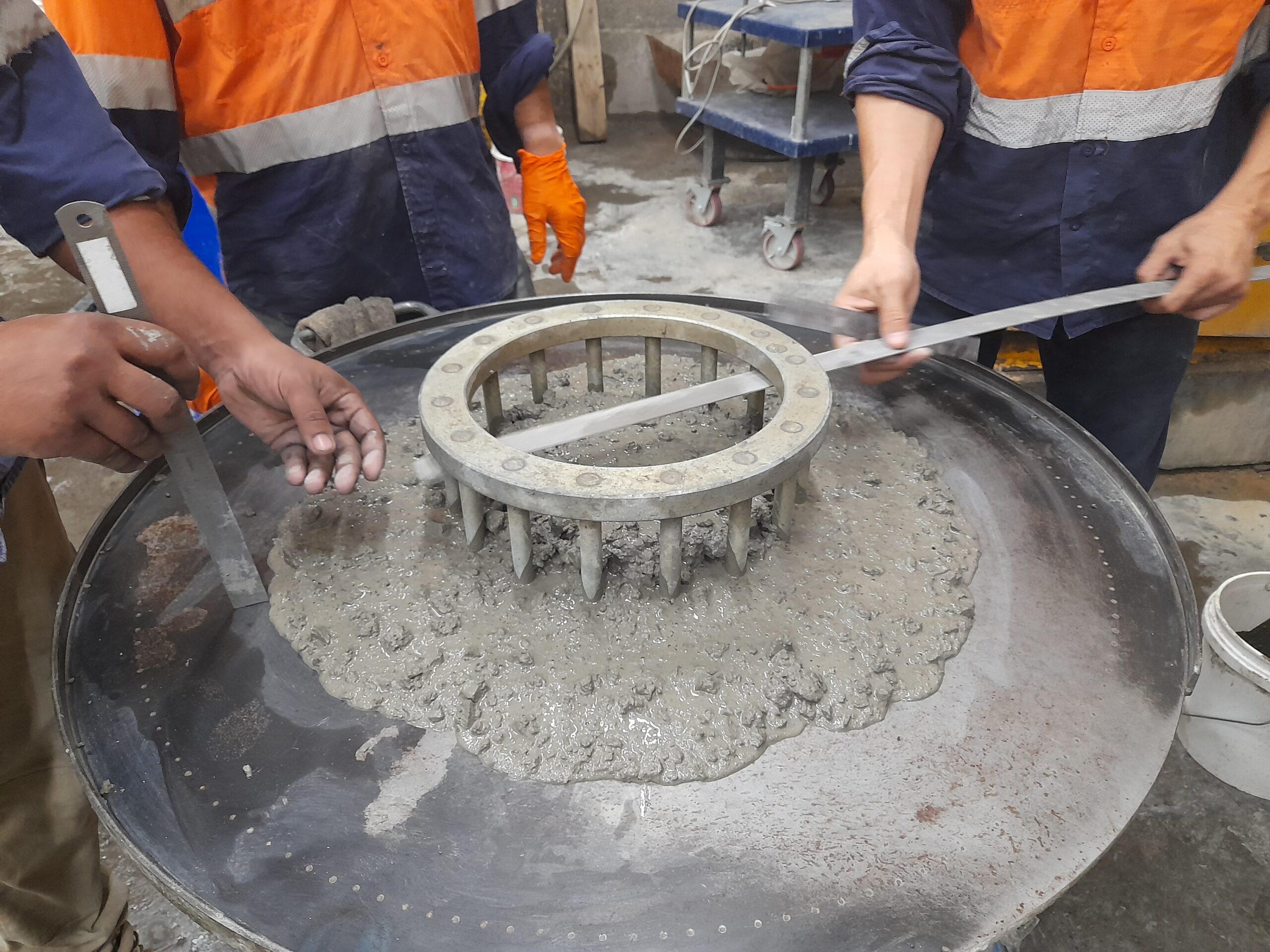
J-Ring Test
Complements the slump flow test by adding vertical rods to simulate reinforcement. The spread difference between the slump flow with and without the ring indicates passing ability.
Advantages of SCC
If you’re managing a high-spec precast plant or a congested structural element on-site, SCC is your best ally. Here is why it works:
Improved Durability
Proper consolidation without vibration reduces honeycombing and voids. This leads to better strength and durability, especially important in aggressive environments or infrastructure like bridges and tunnels.
Labor Cost Reduction
Since SCC flows on its own, manual or mechanical vibration is unnecessary. This results in lower labor requirements, quieter construction sites, and reduced exposure to vibration-related health risks.
Superior Finish and Detailing Quality
The ability to flow and consolidate without segregation ensures smooth surfaces and detailed mold reproduction. It reduces surface voids and bugholes in architectural concrete.
Design Flexibility
SCC makes it possible to cast complex shapes and densely reinforced sections without theoretical voids or incomplete filling.
Productivity Gains
Faster placement, reduced energy usage from equipment, and higher volume conforming in lesser time make SCC ideal for precast and ready-mix operations under tight schedules.
Limitations of SCC
While SCC offers significant advantages, ignoring its limitations compromises your outcome.
Material Cost
SCC uses more cementitious materials and costly admixtures, increasing upfront cost. However, the reduction in labor and increased productivity can offset material costs in many applications.
Sensitive to Mix Variations
SCC has a narrow adjustment window. Small deviations in water, aggregate grading, or admixture dosage affect workability and flow properties. Rigid quality control is mandatory.
Formwork Pressure
SCC exerts higher lateral pressure on formwork due to its ability to flow freely. Temporary formwork systems must be rated appropriately for continuous and uninterrupted placement without bursting or leakage.
Training and QC
Personnel must be trained to test and handle SCC properly. Choking placement without proper training leads to defects and project delays.
Applications in Infrastructure
I have deployed SCC in projects ranging from complex subway structures to heavily reinforced bridges. In these contexts, traditional vibration would have been ineffective or inefficient. Precast operations benefit heavily from SCC, especially in the fabrication of architectural panels and prestressed beams.
For cast-in-place use, SCC excels in repair zones, tall vertical elements, and retrofits where vibration is impractical.
Best Practices for Implementation
The success of SCC is 90 percent preparation and 10 percent placement. Here is what works in practice:
1. Use pre-construction trials to validate the mix design
2. Maintain a robust testing and sampling protocol with skilled QC personnel
3. Monitor true water-cement ratio batch-to-batch
4. Vet admixture compatibility at the plant level before site delivery
5. Watch the temperature; SCC is sensitive to heat, impacting viscosity and flow time
6. Use proper form release agents and seal all joints to prevent leakage
Conclusion
Self-compacting concrete is not a silver bullet, but in skilled hands, it is a potent solution. Whether in precast yards, congested verticals, or complex restoration work, SCC delivers clean finishes, durability, and labor savings. It demands precision in mix design and execution to yield its benefits, but when done right, SCC can outperform traditional concrete in key areas of cost, speed, quality, and performance.
There is no guesswork when SCC is involved. Either the data confirms flow, passing, and stability performance, or it does not. If your project needs a high-performance concrete capable of placing itself with minimal intervention, SCC should be your first option—provided you respect its constraints and control it properly in both plant and field.
